Train. Track. Lead.
Essential Personnel empowers leaders to see the full picture — people, equipment, wellness, and standards — all in one unified platform built for accountability and insight.
%20Sheriff%27s%20Office.webp)
Alamance County Sheriff's Office, NC
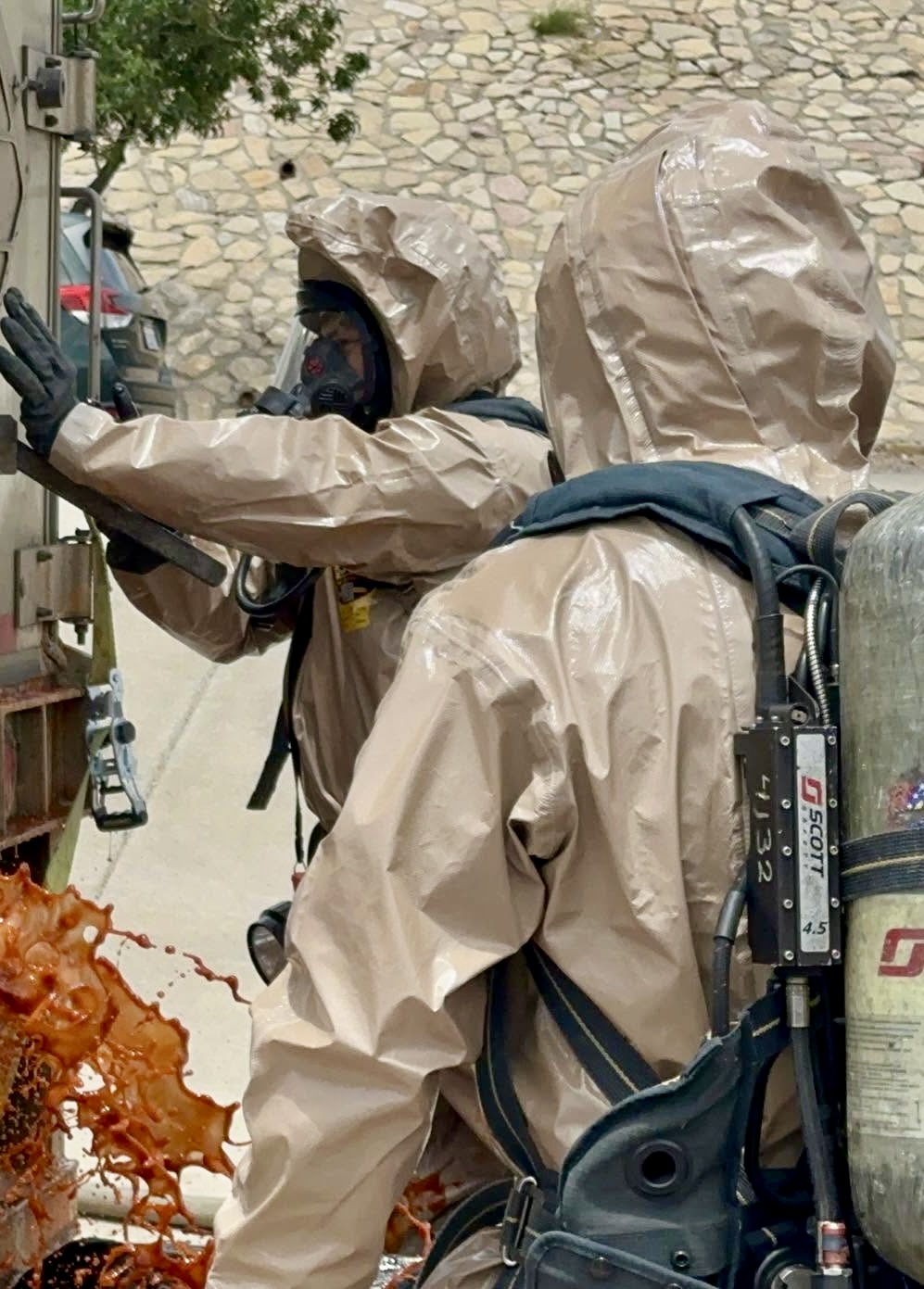
West Pierce Fire & Rescue, WA

New Hanover County Sheriff's Office, NC
%20FD.webp)
Rapid City Fire Department, SD

Pinellas Park Police Department, FL

Lubbock Fire & Rescue, TX

West Pierce Fire & Rescue
%20Sheriff.webp)
Isle of Wright Sheriff's Office, VA

%20DES.webp)
Charles County DES, MD

Lubbock Fire & Rescue, TX
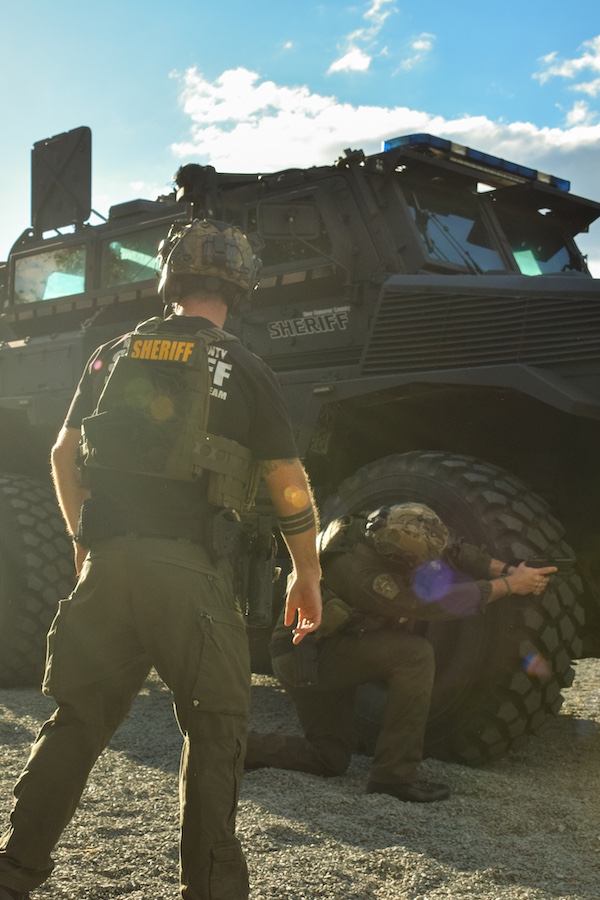
Cherokee County Fire Department, GA

New Hanover County Sheriff's Office, NC

West Pierce Fire & Rescue

West Pierce Fire & Rescue
Your people are your most
Overcoming Public Sector
Personnel Challenges
Government leaders face challenges in recruiting and retaining skilled staff, especially in high-risk and high-visibility local government roles. Our modern Professional Standards software provides tools to enhance culture, drive professionalism and manage talent.

Performance Development

Talent Management

Early-intervention

Communication & Guidance

Capability & Readiness

Training
Winning Teams Choose Essential Personnel

Zach Hickman
Deputy Fire Chief, Iowa City Fire Department

Michael Petti
Major, Fayetteville Police Department

LaSharon Hampton
HR Director, City of Pinellas Park

Kyle Bell
Deputy Chief, Statesville NC Fire Department

Scottie Harris
Chief, Weaverville Fire Department

Mantrese Dodson
Captain, Alamance County Sheriff’s Office

Adam Geissenberger
Chief of Police, Pinellas Park Police Department

Travis Sumption
Sheriff, Clarke County, VA

Tina Medlin
Interim Police Chief, Biscoe NC Police Department

Adam Geissenberger
Chief of Police, Pinellas Park Police Department
Frequently Asked Questions About Public Safety Software
Choosing public safety software is a decision most agencies make once a decade. These are the questions police, fire, and EMS leaders ask us most often, answered plainly.
Professional standards software gives a police, fire, or EMS agency a single system of record for how its people are trained, evaluated, supported, and equipped. Instead of scattering that history across spreadsheets, shared drives, and paper files, professional standards software connects training records, performance documentation, wellness events, and issued equipment to one employee profile.
That matters because most personnel questions are historical. Why was this officer promoted? Was this firefighter current on the certification required for that assignment? Public safety software built for professional standards lets a chief answer from a record rather than reconstruct an answer after the fact. Essential Personnel was designed for exactly that use, which is why agencies tend to evaluate it against point tools rather than general business platforms.
In practice the category overlaps several narrower ones. Agencies usually begin by searching for law enforcement software, internal affairs software, or field training officer software, then find that each of those is a different view of the same underlying employee record. Buying them separately is what creates the reconciliation problem that professional standards software exists to solve.
Generic HR platforms are built around payroll, benefits, and time off. They have no concept of a field training program, a task book, a use of force review, or a traumatic call that should trigger a wellness check. They also struggle to produce the defensible documentation trail an agency needs when a promotion, a termination, or a public records request is challenged.
Purpose built law enforcement software models what public safety actually manages: rank structures, certifications with expiration dates, specialty teams, and serialized gear tied to a named individual. The same is true of fire department software, where readiness reporting and certification currency drive daily staffing decisions. Essential Personnel serves both, with dedicated capability for law enforcement agencies and for fire and EMS departments.
The practical test is simple. Ask whether the system can show every document, training record, incident, and piece of equipment attached to one person on one screen. Generic HR cannot. Law enforcement software and fire department software built for professional standards can.
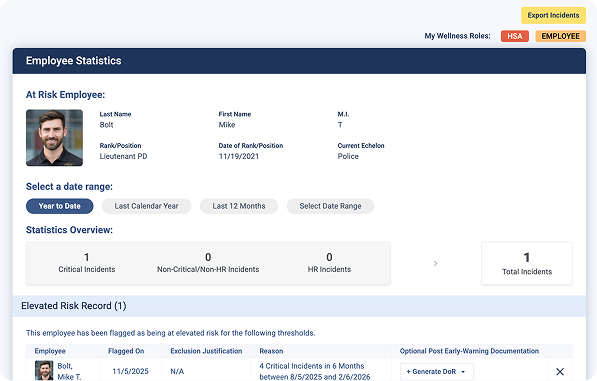
An early intervention system watches for patterns in an employee record that may signal stress, risk, or a need for support, before those patterns become a serious problem. It is not a disciplinary tool. It is a prompt for a conversation.
The Essential Personnel Safety and Wellness suite provides early intervention with customizable thresholds and notifications across tracked events including injuries, use of force, traumatic calls, motor vehicle accidents, and exposures. When a member crosses a threshold, the right people are alerted automatically. Specialist role permissions govern who can view critical incident detail, so sensitive information reaches designated wellness staff without being visible department wide.
An early intervention system is now an expectation in accreditation and oversight discussions rather than an optional extra, and agencies pursuing CALEA accreditation are routinely asked to demonstrate one. Any early intervention system worth adopting should let the agency set its own thresholds, because what constitutes an outlier in a 30 person department is very different from a 900 person department.
One design point decides whether members trust it. Because the early intervention system draws on the same records as first responder wellness tracking, a threshold alert can route to support rather than to discipline. Systems that blur that line get quietly worked around.
Documentation only protects an agency if it is consistent, contemporaneous, and retrievable. A folder of loose notes written after the fact rarely survives scrutiny.
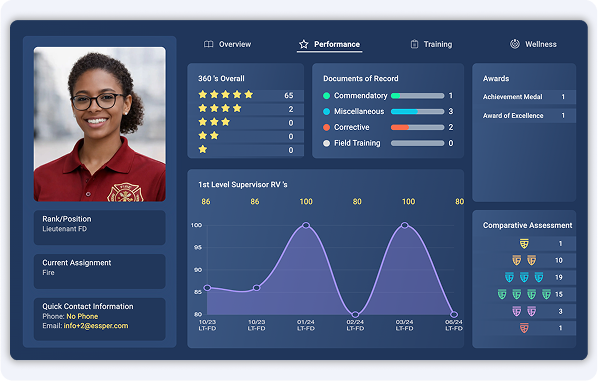
The Essential Personnel Talent Management suite provides Leader's Notes with templates for performance improvement plans, formal counseling, instructor reviews, and field training daily observation reports, plus Documents of Record for commendatory, corrective, and miscellaneous entries with routing and approval workflows. Every entry attaches to the employee profile with a timestamp and an approval trail, and Score Reports apply a normalized scoring algorithm so evaluations can be compared across supervisors rather than reflecting how generous a given rater happens to be.
When a personnel decision is later questioned, leadership can produce the full history in context. That is the single most valuable thing this category of public safety software does.
Yes, and field training is one of the most common reasons agencies come to us. Leader's Notes includes a field training officer daily observation report template, so FTOs document each shift in a structured, comparable format instead of free text that varies by author.
Recruit progress rolls up into Score Reports and Analytics, giving training staff a normalized view of how a class is performing and which recruits need attention while there is still time to act. Agencies evaluating field training officer software usually care most about two things: whether daily observation reports are quick enough that FTOs actually complete them, and whether the resulting data is comparable across a class. Field training officer software that fails either test tends to be abandoned within a year.
Carteret County Sheriff's Office modernized its field training program using Essential Personnel, and Champaign Fire Department applies the same field training officer software through recruit school and probation.
Look for four things: hour and activity logging, event management, certification currency with expiration alerts, and task book tracking. Fire department software that covers only online course delivery still leaves the chief maintaining a certification spreadsheet by hand.
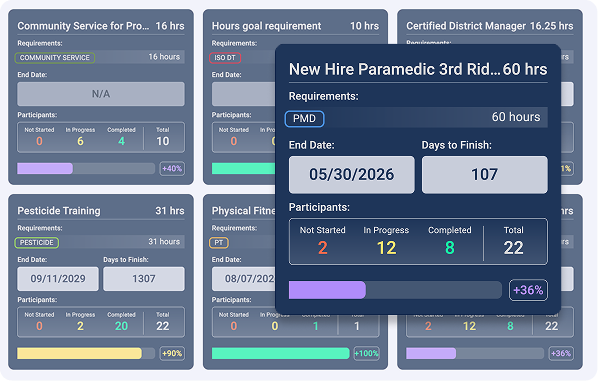
Essential Personnel covers all four. Logbook records training hours, activities, custom goals, and benchmarks. Events tracks training events with attendance and cost, and integrates with Outlook and Google Calendar. Certifications tracks credentials, expirations, completions, and source documents. Qualifications tracks task books, new employee check offs, and specialty equipment check offs.
The payoff is reporting. Accreditation and ISO submissions become a query instead of a quarter long project, and standards recognized by IADLEST and the Center for Public Safety Excellence can be evidenced from live records. West Manatee Fire Rescue used Essential Personnel to improve ISO training tracking, and Myrtle Beach Fire Department uses the same tools for training management. Fire department software should make the annual report a byproduct of daily work.
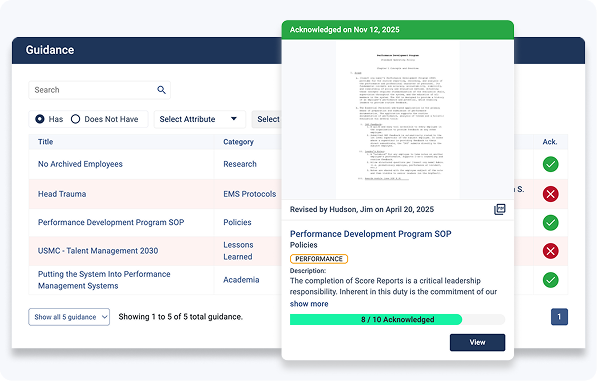
Yes. The Essential Personnel Guidance suite distributes policies, memos, announcements, lessons learned, and research, then captures Employee Acknowledgment so leaders hold a verifiable record that each person received and reviewed the document.
Version Control tracks every revision, allows a revert when needed, and keeps teams working from the current version rather than a copy someone saved locally two years ago. This matters most during audits and litigation, where the question is rarely whether a policy existed. It is whether a specific employee was on notice of that policy on a specific date, and whether the agency can prove it.
Acknowledgement tracking is one of the clearest illustrations of why professional standards software earns its place. The policy itself is easy to write and easy to publish. Proving that a named individual received it, on a date, in the version that was current at the time, is the part that only a system of record can do.
Safety and Wellness builds a wellness profile for each member from tracked injuries, use of force events, traumatic calls, motor vehicle accidents, and exposures. Critical Incident Alerts notify designated staff when a traumatic or critical incident occurs, and specialist role permissions control exactly who receives that detail.
Incident and Case Management records the event, can integrate with your records management system, and auto fills incident reports mapped to state workers compensation documents. A Resource Library lets the agency publish its own wellness documents, videos, and articles so support material sits alongside the data rather than in a separate binder.
First responder wellness programs work best when outreach is triggered by data the agency already holds rather than by self reporting, because the members least likely to raise a hand are often the ones carrying the heaviest cumulative exposure. Tracking exposure over a career, rather than incident by incident, is what turns first responder wellness from an annual reminder into something that actually reaches the right person at the right time. Statesville Fire Department's critical incident tracking through Essential Personnel has been recognized as an industry best practice.
Essential Personnel provides Incident and Case Management for tracking safety and conduct events and building a complete personnel picture, together with Documents of Record and routing and approval workflows for corrective documentation. Hendersonville Police Department streamlined incident reporting and case management on the platform.
Because case management sits in the same platform as performance, training, and wellness, conduct events are recorded alongside the rest of an employee history rather than in an isolated system. That is what allows patterns to surface early enough to act on, and it is the practical difference between internal affairs software that documents outcomes and a platform that helps prevent them.
Agencies comparing internal affairs software should still walk their own complaint intake and investigation workflow through a demo, because requirements vary sharply by state statute, by collective bargaining agreement, and by agency size. Some departments need a full investigative case file with sequestered access. Others need conduct events visible to a standards committee. We would rather map your process than assume a universal fit.
Essential Personnel is aligned with the latest FBI CJIS Security Policy and maintains a SOC 2 Type II report annually, available on request.
The platform is hosted entirely in AWS GovCloud (US), primary in us-gov-east-1 and replicated to us-gov-west-1, with United States based infrastructure and personnel. No data or resources leave the United States. Data is encrypted in transit over TLS 1.2 and above and at rest, both using FIPS 140-3 validated cryptography. Access is governed by hierarchical role based access control enforcing least privilege, with multi factor authentication meeting AAL2 standards that can be enforced agency wide, and full auditability of access.
Agencies comparing CJIS compliant software should ask every vendor for these specifics in writing, since the phrase CJIS compliant software is often used loosely. Hosting region, cryptographic validation, and personnel screening are the details that decide whether a claim holds. Full documentation is on the security and compliance page.
Yes. The Equipment suite tracks serialized gear and tools, consumables and supplies, vehicles and fleet, assignments and transfers, and lifecycle status from issue through retirement.
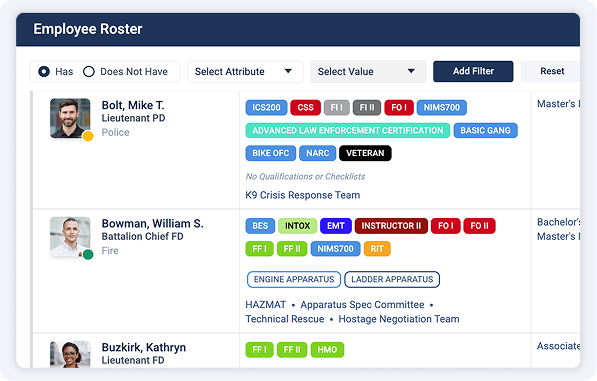
Each employee profile shows everything issued to that person at a glance, combining weapons, vests, radios, and vehicles in a single view. Chain of custody records who held an item, when it was issued, and when it came back, with permanent notation for repairs or handoffs. Multi component assets such as a rifle with an optic, light, and suppressor are tracked as one set with serial numbers recorded at the component level. Fleet records carry unit number, plate, VIN, radio ID, fuel key, camera type, and toll transponder, with GPS provider integration for live location and mileage.
Separation auditing is the capability agencies underestimate. When someone retires or resigns, the system confirms every asset is recovered rather than discovered missing at the next inventory.
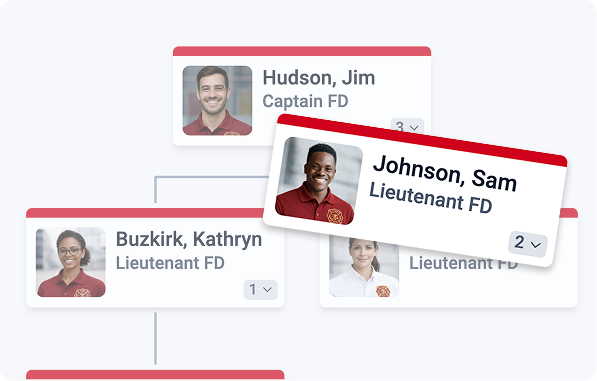
Yes. The Organization Chart provides drag and drop team creation and vacancy management, with real time updates, search and filter, and role based access.
Because the chart is built on the same roster as the rest of the platform, positions stay connected to live personnel data instead of becoming a slide that goes stale the week after it is made. Vacancies are visible as vacancies, which makes the chart genuinely useful for staffing and budget conversations. The Assignments and Special Teams and Committees modules extend this to transfer requests, special team requests, and custom team membership with tracked capabilities.
Pricing is per user, billed annually. The bundled Total Solution is $175 per user, and the four individual suites are available separately from $20 to $85 per user, so an agency can start with one suite and expand. A one time startup fee of $3,000 covers onboarding, support, and training, and optional single sign on is $800 per year per agency. Size based discounts are available.
Published pricing is unusual in this category, which means agencies can benchmark Essential Personnel against quote only vendors before committing to a procurement process. Current figures are always on the pricing page.
Those tools are strong at what they were built for. Guardian Tracking focuses on performance documentation and early intervention. PowerDMS and Lexipol focus on policy management, policy content, and acknowledgement.
The difference is scope. A single Essential Personnel deployment covers what agencies otherwise assemble from separate purchases: law enforcement software for performance development, internal affairs software for case management, an early intervention system, training and credential management, policy publishing with acknowledgement tracking, first responder wellness and critical incident tracking, and equipment accountability. All of it runs on one roster, and all of it is CJIS compliant software hosted in a single environment.
Agencies running several point tools usually end up maintaining that roster in each one, reconciling by hand, and still having no single view of an employee. That reconciliation work is invisible on a price comparison and expensive in practice.
The honest way to evaluate this is to count your current systems and ask what it costs to keep them in sync. If you run one tool and it fits, switching may not be worth it. If you run three or four and your roster lives in all of them, consolidation is usually where the return is. Our team will tell you which situation you are in.
Yes. Essential Personnel is available through GSA Advantage, NASPO, Omnia Partners, NCSA, and VSA.
For many agencies this is the difference between deploying this fiscal year and waiting for the next budget cycle, because a cooperative contract vehicle can remove the need for a separate competitive solicitation. It also shortens security review, since the CJIS compliant software documentation most purchasing offices ask for is already assembled.
Confirm with your purchasing office which vehicles your jurisdiction accepts, then contact our team and we will supply the contract documentation your procurement process requires.
Still deciding whether purpose built public safety software is right for your agency? Walk through your own workflow with our team.
Request a Demo